

Audiogram: the graph that reveals your hearing health
Monitoring your hearing health is important, but how do we assess ears? The audiogram is the primary measurement obtained during an audiological evaluation.
But what is an audiogram?
Audiogram: What is it?
| The audiogram is a graph used to measure the faintest sounds a person can hear. It is divided into two components, frequency and intensity. For each frequency, the intensity (volume) required for the sound to be heard is determined, which then allows a curve to be drawn representing the person’s hearing. This graph therefore allows us to check whether there is hearing loss and, if so, to determine the degree. | 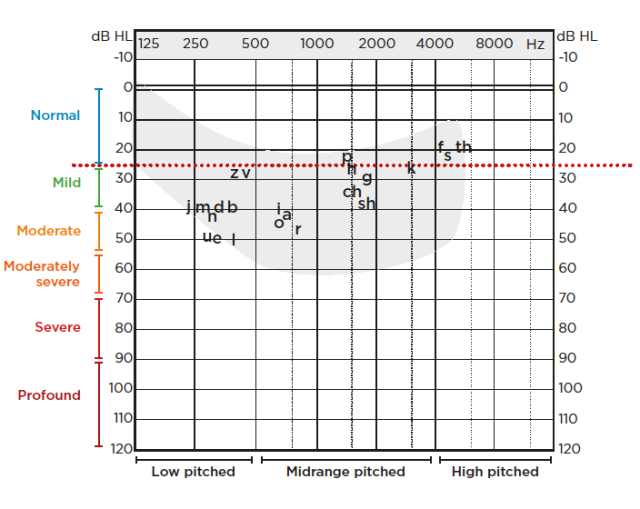 |
The frequency
Frequencies are located on the horizontal axis of the graph (from left to right). This is the tone of the sounds, i.e. low, medium and high-pitched sounds. Like a piano, the frequencies are represented from the lowest pitched sounds (on the left) to the highest pitched sounds (on the right). They are measured in Hertz (Hz). The audiogram does not measure all the frequencies heard by humans, but rather the main tones of speech, generally from 250 to 8000 Hz.
The intensity
Intensity is found on the vertical axis of the graph, from top to bottom. It is the strength or volume of the sound. It is measured in decibels (dB). At the top of the graph, we find the soft sounds and the further down we go, the louder the sounds are.
Symbols and curves
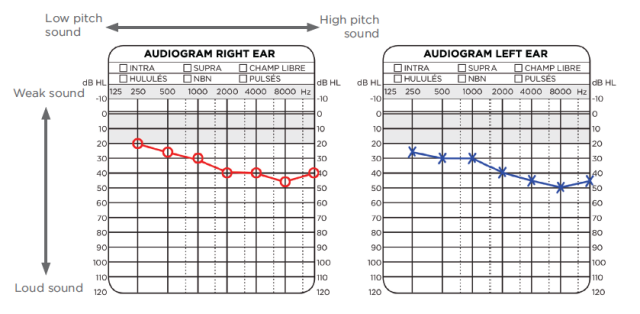
The results are written in the form of symbols, “O”s for the right ear and “X”s for the left ear, which are then connected to create a curve for each ear. When the symbols are in the gray area, at the top of the graph, this implies that hearing is within normal limits (from 0 to 20 dB). When the symbols are in the white area, it means that there is hearing loss; the lower the symbols are in the graph, the greater the hearing loss. There is also a dotted line, which represents the results of the inner ear (cochlea). This last result makes it possible to determine the nature of the hearing loss, whether conductive, sensorineural or mixed.
It’s important to keep in mind that the audiogram does not reveal everything about a person’s hearing and hearing health and that it’s one measurement among several carried out during an audiological evaluation.
It’s important to consult an audiologist if you have any doubts or questions about your hearing!